The Power of Collaboration
The 12th UBC Symposium
Friday 2 October at 8:30h at Hogeschool Utrecht
UBC Symposium - The Power of Collaboration
We are pleased to announce the 12th UBC Symposium: The Power of Collaboration, taking place on Friday 2 October 2026 as part of Utrecht Science Week.
Join us at Hogeschool Utrecht (University of Applied Sciences Utrecht), Padualaan 101, Utrecht, for a day of inspiring talks, networking, and knowledge exchange within the Utrecht bioinformatics community.
Registration is now open and free of charge. We encourage participants to submit a poster abstract to showcase their research, connect with colleagues, and compete for the UBC Poster Prize.
We are currently finalizing the programme, so save the date, register, and stay tuned for more details.
Program
08:30 — Registration
09:00 — Welcome by the UBC Executive Board & HU
09:15 — Keynote dr. Saskia Haitjema
09:45 — Keynote dr. Halima Mouhib
10:15 — Coffee Break
10:45 — Pitch Talks: Genomics Insights & Applications
12:00 — Lunch
13:00 —Keynote dr. Justin J.J. van der Hooft
13:30 — Keynote dr. Jasmijn Baaijens
14:00 — Poster Session
15:00 — Coffee Break
15:30 — Pitch Talks: Computational Methods & AI in Bioinformatics
16:45 — Closing Ceremony & Awards
17:00 — Drinks & Networking
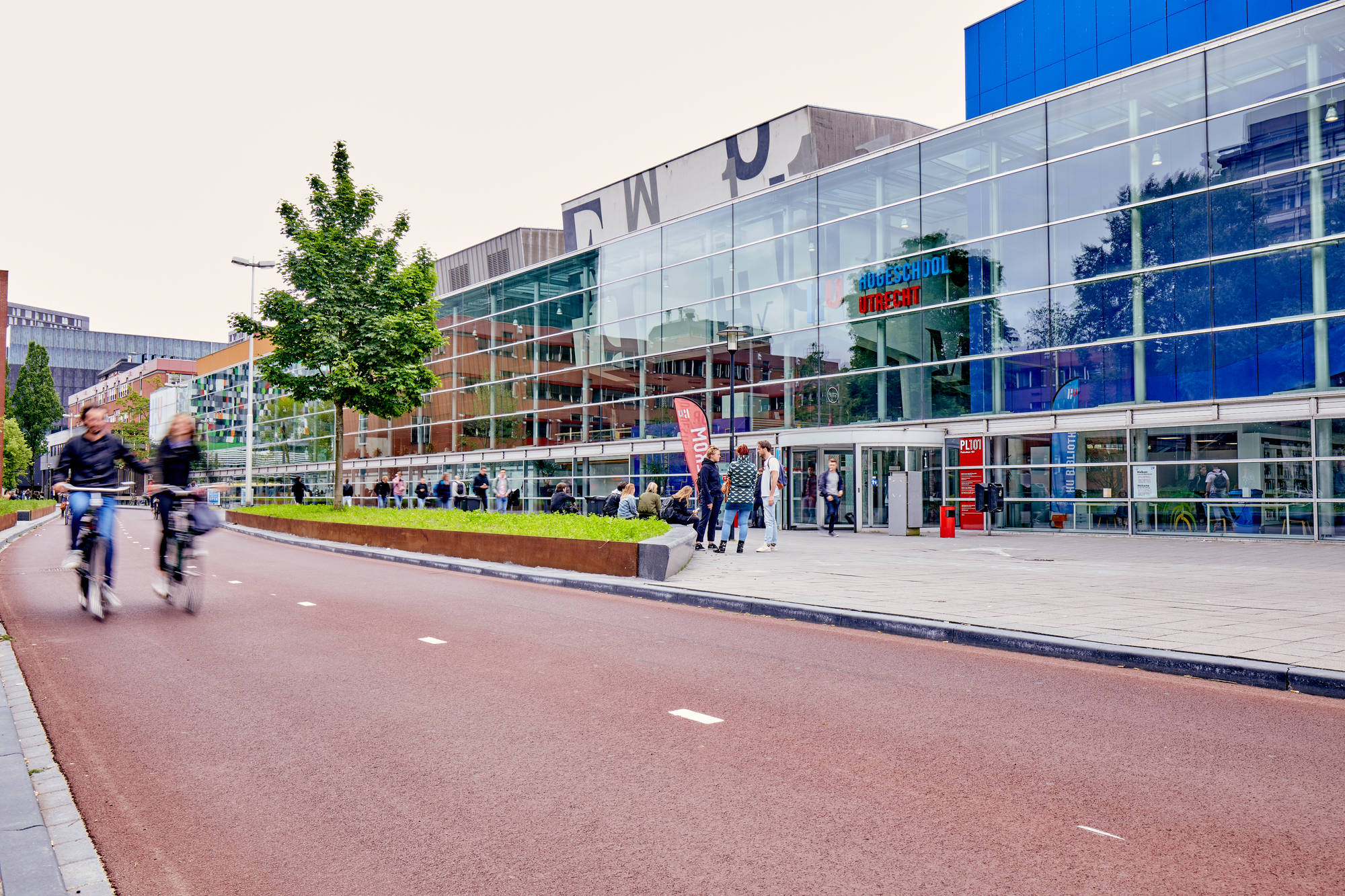
University of Applied Sciences Utrecht
Padualaan 101, 3584 CH Utrecht
Keynote speakers

Jasmijn Baaijens is a bioinformatician and assistant professor at TU Delft with a focus on pathogen genomics. She develops algorithms and software to leverage sequencing data for reconstructing microbial genomes, enabling the characterization of pathogen diversity in patient or community samples. With a background in mathematics, she earned her PhD in viral genomics at CWI and expanded her expertise in bacterial genomics during a postdoc at Harvard Medical School. She is also a member of the European Virus Bioinformatics Center and advocates for gender equality in academia through mentorship and outreach initiatives.
Keynote talk
As genomic reference databases continue to grow, the question of how we represent biological diversity is becoming increasingly important. More reference genomes do not necessarily translate into better metagenomic analyses: redundancy can reduce computational efficiency, while closely related genomes and lineages can blur the boundaries between taxa and distort abundance estimates. So how do we select references that capture diversity while remaining computationally tractable and biologically informative?
I will explore this question through metagenomic profiling, using benchmarking experiments to understand the impact of reference selection on profiling accuracy. In particular, we ask when and why selecting a subset of references can improve performance. This motivates ReSeT, an optimization-based approach that jointly considers coverage within taxa and separation between taxa, providing a principled alternative to conventional dereplication. More broadly, this work points toward a shift from simply accumulating reference sequences to deliberately designing computational representations of biological diversity.
Saskia Haitjema is an associate professor at the Central Diagnostic Laboratory and head of the Utrecht Patient Oriented Database (UPOD). Her research focuses on improving diagnostics and personalizing healthcare through data analytics, using routine hematology characteristics and large datasets.
She studied Medicine and Linguistics at Utrecht University and completed her PhD in Experimental Cardiology in 2017. Dr. Haitjema leads a vibrant data science community, supervises PhD candidates, and participates in multiple European research projects. She is also actively involved in education and strategic initiatives to advance digital health and AI in healthcare.
Keynote talk
Many digital health solutions that are developed never reach clinical practice. Collaborating in multidisciplinary teams is an important prerequisite for implementation success. Based on experience from local, national and international projects, I will discuss the necessary members of multidisciplinary teams, their roles en their much needed interaction in innovation pipelines to create value in digital health.
Halima Mouhib is an associate professor and co-head of the Bioinformatics group in the Computer Science department at VU Amsterdam. Her research focuses on understanding complex biological phenomena, such as olfaction and taste, using machine learning and multi-scale computational techniques.
She obtained her PhD at RWTH Aachen University, specializing in the characterization of odorants and volatile organic compounds. She later expanded her expertise into structural bioinformatics and computational biophysics, and was awarded the Descartes-Huygens Prize in 2021 for her work on odorant absorption.
Keynote talk
In contrast to hearing and vision, the exact function of the olfactory sense remains largely unknown. This impacts many research areas ranging from fragrance chemistry to odor perception, as well as sensor design in artificial noses. Recent advances in AI technologies started to pave the way towards digitizing odors for structure-based odor predictions and broadening our understanding of structure odor relationships. However, there are still many open ends and questions before the sense of smell is successfully digitized, and new knowledge can be transferred to other applications such as bio-mimetic sensor design.
One problem that is currently holding back the advancement in the field of artificial noses is our fragmentary understanding of the molecular detection mechanisms underlying the olfactory sense. During the talk, I will give an overview of the advances and challenges in the field and show different projects that our team is working on at the VU Bioinformatics group of the Vrije Universiteit Amsterdam. Here, one of our main objectives is to unravel and to quantify the uptake mechanisms of odorants and other volatile organic molecules through binding proteins for applications in bio-mimetic sensor units. In future, due to the increasing number of available data on molecular structures and olfactory properties, machine learning and more data-driven approaches will be necessary to address new computational challenges and thus, in the long term, allow us to move towards the digitalization of the olfactory sense.
Justin J.J. van der Hooft is an Assistant Professor in Computational Metabolomics in the Bioinformatics Group at Wageningen University & Research, NL, and an author of >100 peer-reviewed articles in the metabolomics field. Justin is very fascinated by the ingenuity of nature in creating marvellous chemical structures. He obtained his PhD (2012) in Systematic Metabolite Annotation and Identification at the Biochemistry and Bioscience groups in Wageningen. After a postdoctoral period in Glasgow, UK, studying both analytical and computational aspects of metabolite structure annotation, and together with Joe Wandy & Simon Rogers coining MS2LDA unsupervised substructure discovery, he returned to Wageningen. Since 2020, his team has been developing computational metabolomics strategies to decompose mass spectral data into structure and substructure information. By linking genome and metabolome mining, his team studies plant, food, and microbiome-associated metabolites to find novel bioactive metabolites. Recently developed tools and frameworks include SpecReBoot for confidence-aware molecular networking, MS2Query to perform analogue search, FERMO to prioritize metabolite features and profiles by enabling effective and reproducible data integration and data filtering strategies, and NPLinker to handle multi-omics data for natural products discovery. Since 2022, he is also a Visiting Professor in Johannesburg. Justin is a strong advocate of Open Science and Collaborative Community-driven research, as evidenced by his team’s contributions to matchms, NPLinker, MIBiG, and the foundation of the Paired Omics Data Platform. Got interested? Find out more and meet the team here: https://vdhooftcompmet.github.io. You can find his contributions to the metabolomics field here: https://scholar.google.nl/citations?user=zv9seLwAAAAJ&hl=en&oi=ao.
Keynote talk
Nature has always been a rich resource of diverse chemistry. Fortunately, in recent years, technological advances in the omics fields have increased our capacity in measuring them. For example, modern mass spectrometers generate information-rich chemical profiles used for untargeted metabolomics studies. Such studies are typical examples of exploratory data analysis, as one does not a priory know what one will discover in the data. However, the current information-rich metabolomics profiles leave researchers with the daunting task to separate valuable signals from everything else.
In this talk, I will highlight recent advances in networking and machine learning-based strategies to organize and annotate metabolite features. These include the work on the SpecReBoot framework that boosts library matching by offering query-focused match scores, and enhances molecular networking organization by trimming unwanted spectral links and focusing on more reliable connections. Another key framework I will showcase is MS2LDA unsupervised substructure discovery to complement spectral library-based annotation by substructure annotations. Both frameworks originate from cross-discipline collaborations to connect the dots in a meaningful manner.
I will finish the talk with highlighting the important role of Open Science and Software in stimulating community-based science. Altogether, I expect that the presented progress in computational metabolomics tools will empower metabolomics researchers navigating their increasingly complex datasets to find and annotate relevant and novel chemistry in nature.
Pitch Talks
| Title | Speaker | Group |
| X chromosomal gene expression is linked to an inflammatory plaque phenotype in women with severe atherosclerosis | Anna Spiering | Ernest Diez Benavente |
| The Landscape of Chromosomal Instability in Pediatric Solid Tumors | Roula Farag | Jayne Hehir-Kwa |
| From Genotype to Electrophysiology: AI-Derived ECG Latent Factors Reveal 48 Novel Loci in 76,000 UK Biobank Genomes | Jade Raffle | Jessica van Setten |
| Rare variant analysis at scale: from exomes to actionable biology in ALS and Parkinson’s disease | Paul Hop | Kevin Kenna |
| Direct haplotyping of parents enables untargeted non-invasive prenatal diagnostics | Joanna von Berg | Hanneke van Deutekom |
| From germline variant to pediatric cancer: detecting DNA repair deficiency through somatic footprints | Lianne Suurenbroek | Roland Kuiper |
| Title | Speaker | Group |
| A bulk gene expression foundation model for clinical cancer prediction | Joske Ubels | Jeroen de Ridder |
| Modeling meets transcriptomics: understanding how plants forage for nutrients | Eva van Zelm | Kirsten Ten Tusscher |
| DeepPheno: A Deep Learning Framework for linking Hyperspectral Imaging and SNP Genotypes in Lettuce | Frank Okyere | Sanne Abeln |
| Bioinformatics uncovers pregnancy-associated glycosylation patterns in plasma | Grigory Reznikov | Pavel Sinitcyn |
| pip install refs-mcc: Out-of-the-Box Feature Selection for High-Dimensional, Low-Sample-Size Omics Data | Brigitta Varga | Alejandro Lopez-Rincon |
| Project based collaborations at the HogeSchool Utrecht | Chris van Oevelen & Berend Wilkens |